
Psychopedagogy
Learning with the Mind: Attention, Understanding, and Memorization. What Really Happens When We Learn?
We don't learn simply to remember something once. We learn so we can retrieve, connect, and use our knowledge over time.
13 min

n our previous article, we discovered that learning is not an exclusively mental process, but one that involves three essential dimensions: the mind, the heart, and the body.
Today, we will begin exploring each of these dimensions in greater depth, starting with the mind.
Within this dimension, we find five fundamental mental gestures: attention, understanding, memorization, reflection, and imagination.
In this first article, we will focus on the first three. We will explore what attention really means, how it differs from concentration, how we can tell whether a child has understood what they are learning, and what actually happens when we memorize information.
Because before asking a child to learn, perhaps we should first ask ourselves whether we truly understand how learning works.
1. Attention: What Does It Really Mean to Pay Attention?
- Attention is the selection of information that enters our minds from the outside world through our five senses.
We are constantly surrounded by stimuli: sounds, images, movements, sensations, and words. However, we cannot process all of them with the same intensity at the same time.
Attention allows us to select the information that is relevant at a given moment and direct our mental resources toward it.
Imagine a child reading a written instruction on a worksheet. At that moment, they are primarily using their visual sense to select the information they need to process. Even though other stimuli may be present around them, their attention is directed toward the words they are reading.
When we direct our attention toward one stimulus, other stimuli may temporarily move into the background.
This ability is essential for learning and cognitive functioning because it allows us to select information and reduce interference from distractions.
But I would like to pause here for a moment.
When we tell a child, "Pay attention!", do we really understand what we are asking them to do?
Do we understand that it involves much more than simply looking at us or listening to what we say?
When we explain a topic, a child needs to select the words, concepts, and relationships they are receiving in order to process them and build new knowledge.
Yet, as teachers and adults, we often repeat phrases we ourselves heard during childhood without stopping to understand the processes they actually involve.
And there is another question I consider equally important:
Do we understand our own attention process? Do we know what helps us maintain our attention and what causes us to lose it?
Understanding how attention works is the first step toward better supporting children's ability to pay attention.
2. Attention and Concentration: Are They the Same Thing?
Although we often use these two words as if they were interchangeable, attention and concentration do not represent exactly the same process.
From the perspective of the mental gestures explored in Positive Educational Psychology, we can understand them as two complementary movements.
- Attention is a movement from the outside world toward our inner world. We select the information we receive through our senses. - Concentration is a movement that begins within us and allows us to keep our mental activity directed toward a task, engaging our will and resisting distractions.
Concentration involves the ability to remain engaged in an activity, explore it in greater depth, and gradually become less aware of stimuli that are not relevant to the task.
Let's look at an example from the classroom:
- Reading an instruction = requires attention. - Solving the exercise by following that instruction = requires concentration.
To solve the exercise, a child needs to keep their thinking focused on the task, retrieve information, establish connections, and make decisions.
It is important to understand that these two processes do not necessarily happen one after the other. They can take place simultaneously and continuously complement each other.
For example, while solving a math problem, a child needs to pay attention to the information in the question while also concentrating on finding a solution.
However, coordinating these processes can require considerable effort for some children, especially those with specific learning difficulties or difficulties regulating their attention.
That is why, when a child appears distracted, it does not always mean that they do not want to learn or that they are not trying.
Perhaps the activity requires too many processes at once. Perhaps they need clearer instructions, fewer distractions, or a different way of accessing the information.
As adults, our responsibility is to observe before we judge.
We cannot demand concentration without first understanding what a child needs in order to achieve it.
3. Understanding: Learning Is More Than Simply Listening
We have now reached one of the most important mental gestures involved in learning: understanding.
Have you ever explained something to a child, asked whether they understood, and received a "yes" in response, only to discover a few minutes later that they had not really understood at all? This happens very often.
Understanding is the ability to establish connections between new information and what we already know.
A child has understood something when they are able to find meaning in what they are learning, relate it to previous experiences, and use that knowledge to explain, interpret, or solve a situation.
That is why one of the best ways to observe whether a child has understood something is to ask them to explain what they have just learned in their own words.
We can also ask them to give us an example that is different from the one we used during the explanation.
If they are able to establish new connections and apply what they have learned to another situation, we have an indication that they are developing a deeper understanding.
But there is something important we must remember: understanding is neither an automatic nor an isolated process.
For understanding to develop, the different mental gestures need to work together.
Let's think about this:
- Without attention, new information may not be selected appropriately. - Without concentration, it may be difficult to sustain the mental effort needed to work with that information. - Without memorization, a child may struggle to retrieve previous knowledge that would help them establish new connections. - Without reflection, they miss opportunities to analyze, question, and connect what they are learning with other knowledge. - Without imagination, they may find it more difficult to explore possibilities, create new connections, and discover different solutions.
The five mental gestures complement one another and contribute to the construction of meaningful learning.
That is why, when a child does not understand a concept, repeating the explanation more times is not always what they need.
Perhaps we need to present it differently, revisit previous knowledge, use concrete examples, or give them an opportunity to experiment.
Sometimes, the difficulty does not lie in the child's ability to understand, but in the way we are presenting what we want them to learn.
4. Memorization: Does Memorizing Mean Learning?
We often reduce learning to the ability to memorize information successfully.
We think a child has learned something when they can correctly repeat a definition, a date, a formula, or a multiplication table.
But is that enough?
Imagine a child who knows their multiplication tables perfectly. They can quickly tell you how much 6 × 4 or 8 × 7 equals.
However, when we ask what multiplication actually means, they cannot explain it or relate it to an everyday situation.
What has happened?
It is possible that they have memorized the answers through repetition but have not yet developed a deeper understanding of the concept.
Multiplication is not simply about remembering results. It also involves understanding that we can represent multiplication as repeated addition of equal quantities, among other mathematical interpretations.
The same phenomenon can appear in other areas of learning, such as verb conjugation, grammar, history, and science.
A child may memorize a grammatical rule without understanding when and why to use it.
That is why we must remember that memorization is essential, but it cannot replace understanding.
So, what is memory, really?
Memory is our ability to encode, store, and retrieve information when we need it.
To better understand how it works, we can distinguish between two major systems:
1. Working Memory Working memory is the system that allows us to temporarily hold and manipulate a limited amount of information while carrying out a task.
For example, when a child solves a math problem, they need to keep certain numbers in their mind while completing the different steps.
Its capacity is limited, and the information it holds remains available for a relatively short period unless it is actively used or consolidated into long-term memory.
2. Long-Term Memory Long-term memory is the system that allows us to retain knowledge, experiences, concepts, and skills over extended periods of time.
Its capacity is extraordinarily large, although this does not mean that we remember everything we have learned or that we can retrieve any information whenever we want.
Both systems work together during learning. For example, when a child learns a new mathematical operation, they need to use working memory to process the information. Through practice and consolidation, that knowledge can eventually be retained in long-term memory.
How Can We Help Children Memorize More Effectively?
One of the keys is to offer different ways of representing and retrieving information.
Not all children establish the same connections with what they learn. Therefore, enriching the learning experience through different resources can make it easier to encode and retrieve knowledge.
We can use:
- Colors: to distinguish categories, highlight information, and create associations. - Shapes and images: to represent concepts and create visual references. - The senses: to experiment, manipulate, observe, and connect information with concrete experiences. - Emotions: because emotionally meaningful experiences can influence the way we encode and remember information. - Movement: to support certain learning processes through gestures and physical actions.
The more meaningful connections we can build, the more opportunities we create to retrieve information later. The goal is not to overwhelm children with stimuli, but to offer experiences that make sense to them and allow them to establish connections.
The Forgetting Curve: Why Do We Need to Reactivate Memory?
Reactivating a memory is one of the most interesting ideas when we talk about memorization.
Have you ever studied something and remembered it perfectly the following day, only to find that a week later it seems to have disappeared?
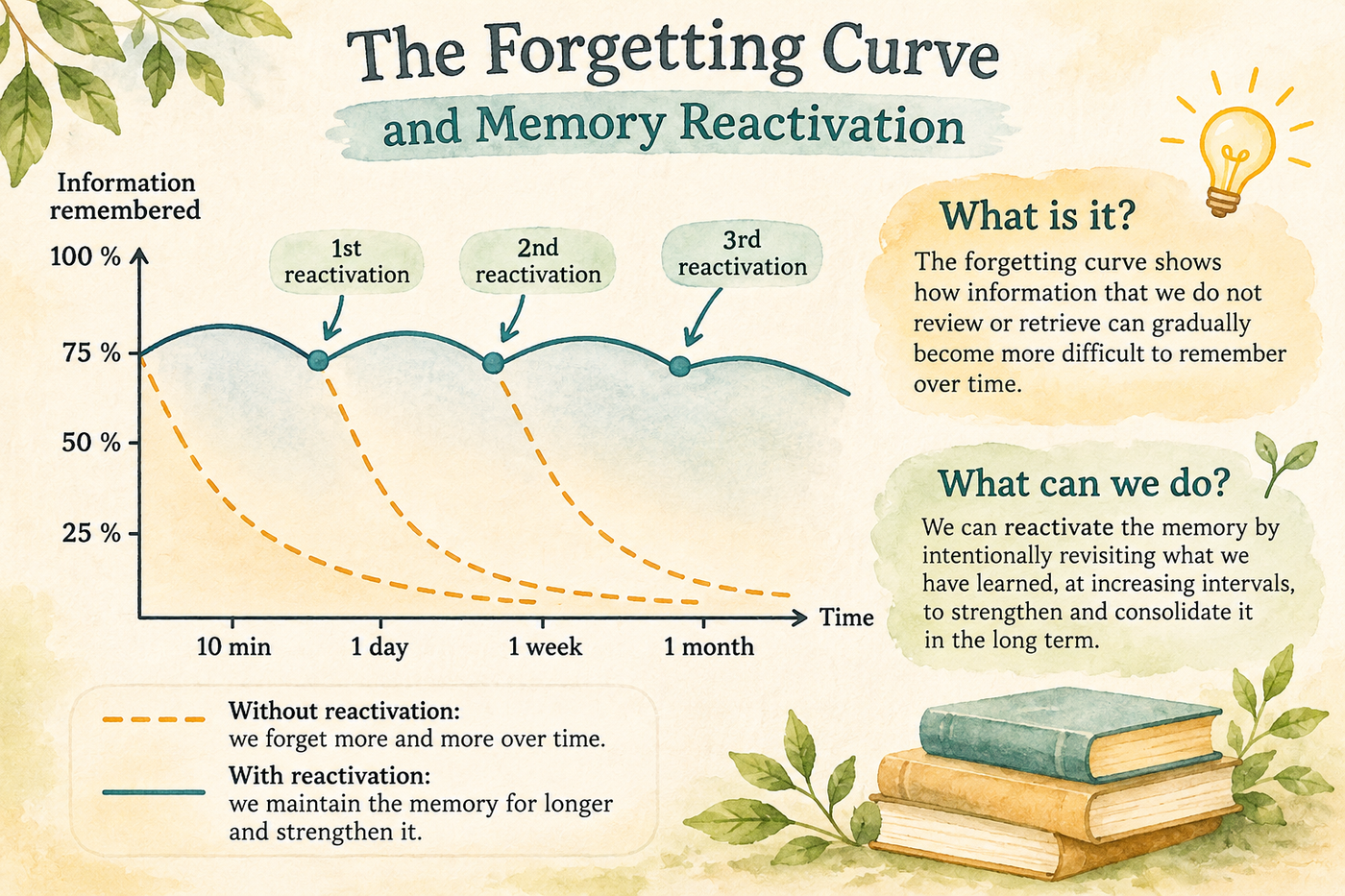
This is related to a phenomenon known as the forgetting curve, studied by Hermann Ebbinghaus.
The curve illustrates how information that we do not retrieve again can become progressively more difficult to remember over time.
But here comes the interesting part: we can influence this process.
When we actively retrieve information we have previously learned, we strengthen our ability to remember it in the future. We can call this process memory reactivation.
In the illustration, we can observe two different patterns:
- The dashed lines represent how recall may decline when we do not revisit or retrieve the information. - The solid line represents how successive reactivations can help maintain the memory for longer and slow down forgetting.
Every time we retrieve information again, we reinforce the connections that allow us to access it. That is why we do not need to wait until a child has completely forgotten something before revisiting it. We can organize short retrieval sessions spaced out over time.
For example:
- First encounter: We introduce and work with a new concept. - First reactivation: We revisit the information after a short interval. - Second reactivation: We return to the concept the following day or in the days that follow. - Further reactivations: We revisit it again after progressively longer intervals.
These intervals do not need to be identical for every child or every subject. They depend on the difficulty of the material, prior knowledge, and how easily each child can retrieve the information.
Furthermore, reactivating memory does not simply mean rereading the same text.
We can ask a child to explain what they remember, solve an exercise without looking at their notes, answer questions, make associations, or use the concept in a different situation.
Memory becomes stronger not simply when we look at information again, but when we make the effort to retrieve it.
This principle is particularly valuable when supporting children's learning. Instead of accumulating new content without returning to what came before, we need to give children opportunities to retrieve, connect, and consolidate what they have already learned.
Learning Is Much More Than Accumulating Information
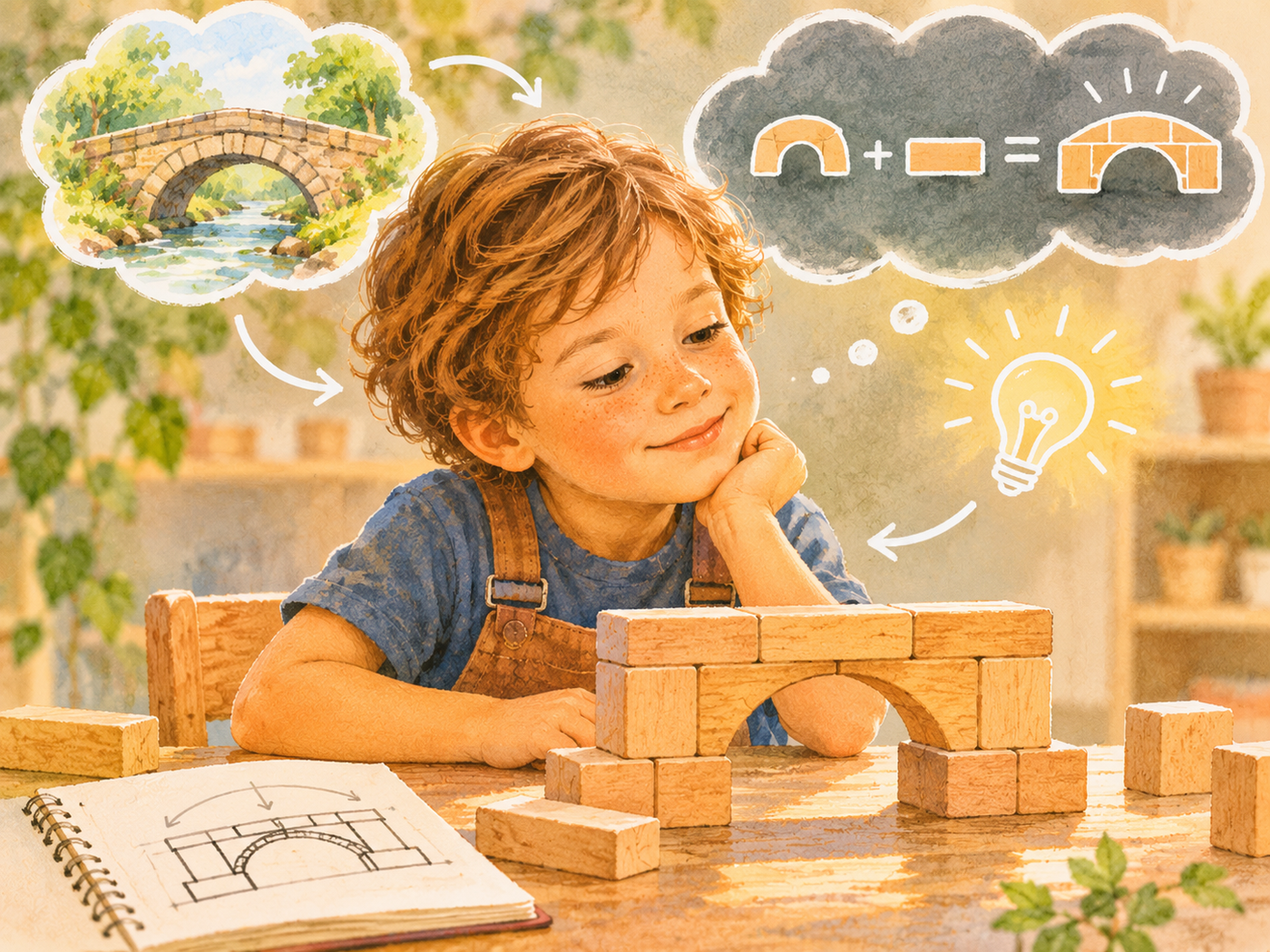
In this first exploration of the mental gestures, we have discovered three fundamental processes: attention, understanding, and memorization.
We have also seen that none of them works in isolation. Each one needs the others in order for meaningful learning to take place.
And there is something I would like us to take away from this article:
When a child struggles to learn something, our first reaction should not be to demand that they try harder, pay more attention, or repeat the exercise one more time.
Before doing so, we should ask ourselves:
Have they been able to select the information they need?
Have they had the conditions necessary to concentrate?
Have they truly understood what we are teaching?
Do they have previous knowledge that allows them to establish new connections?
Have we given them opportunities to retrieve and consolidate what they have learned?
As adults and educators, we have much to learn about how our own minds work and how the minds of the children we accompany work.
Because teaching is not simply about transmitting information. It also means understanding the processes that allow information to become knowledge.
What Will We Discover in the Next Article?
In this article, we have explored three of the five mental gestures involved in learning: attention, understanding, and memorization.
In the next article, we will explore the remaining two: reflection and imagination.
We will discover why they are essential for developing thinking, establishing new connections, solving problems, and finding different ways of understanding the world.
Later on, I will also share practical activities and tools that we can use both at home and in the classroom to support the development of these mental gestures.
Let us remember that, for now, we are exploring only one of the three fundamental dimensions of learning: the mind. We will then explore the heart and the body, because learning involves much more than thinking.
A Recommendation for Further Learning
I would like to encourage you to follow the work of La Fabrique à Bonheurs, the organization where I completed my training and certification as a Positive Educational Psychology Practitioner.
Their work has allowed me to deepen my understanding of learning processes and discover tools for supporting both children and adults from a more holistic perspective.
I invite you to explore their work and resources.
Because if we want to better support children in their learning, we must never stop learning ourselves.